
Claiming the Right to Breathe: How Indians Resisted Toxic Air

Introduction
By 2025, air pollution in India had crossed a psychological threshold. It was no longer experienced only as a harsh winter episode or an unfortunate side effect of urbanisation. For millions of citizens, polluted air had become a constant backdrop to daily life, affecting how children went to school, how the elderly stepped outdoors, how families planned their routines, and how communities perceived their own health and safety. What truly set 2025 apart, however, was not just how bad the air became but how ordinary citizens responded. Increasingly, people refused to treat toxic air as inevitable. Instead, they asserted that clean air is not a privilege, but a right, and they were willing to fight for it.
A key instrument in this shift was the Public Interest Litigation (PIL). In India, PILs allow citizens to approach constitutional courts on issues that affect the public at large, even if the petitioner is not personally aggrieved in a narrow legal sense. Over the years, PILs have shaped environmental governance in India, from vehicle emission norms to industrial regulation. In 2025, citizens once again turned to this tool, but with a sharper focus: air pollution as a public health emergency and a constitutional violation.
The Courts as Arenas of Public Health and Rights
One of the most prominent petitions of the year reached the Supreme Court through Luke Christopher Coutinho, a wellness expert and public health advocate. His PIL sought to have India’s air pollution crisis formally recognised as a national public health emergency. What made this petition particularly influential was its framing. Rather than treating air pollution as a seasonal administrative challenge, it positioned polluted air as a chronic health threat, linked to rising respiratory illness, weakened immunity, cardiovascular disease, and long-term developmental impacts on children. The petition argued that advisory measures and symbolic interventions were no longer sufficient, and that the scale of harm demanded legally enforceable, health-centric responses. In doing so, it helped move the air pollution conversation firmly into the domain of public health and constitutional rights.
The legal momentum was not confined to the national capital or the Supreme Court. In eastern India, advocate Akash Sharma filed a PIL in the Calcutta High Court, addressing persistently poor air quality in the Kolkata–Howrah region. His petition argued that when a city repeatedly experiences “very poor” air quality, such conditions should automatically trigger a public health emergency response, rather than being treated as routine or unavoidable. This intervention was significant because it challenged the normalisation of polluted air in cities that do not always dominate national headlines. It reinforced the idea that air pollution is not a Delhi-only problem, but a nationwide urban crisis that requires city-specific accountability and action.
In Delhi itself, citizen action often took a more local and community-rooted form. The Greater Kailash-II Welfare Association, represented by its General Secretary Sanjay Rana, filed a petition in the Delhi High Court demanding urgent and scientific measures to address air pollution. This PIL emerged directly from lived neighbourhood experience, with residents daily dealing with construction dust, traffic emissions, and deteriorating air quality. Importantly, it reflected a growing trend of Resident Welfare Associations stepping into environmental advocacy roles. These groups were no longer limiting themselves to civic amenities; they were documenting pollution sources, questioning enforcement gaps, and demanding structural solutions through the courts.
Another Delhi High Court petition highlighted a different but equally critical dimension of the air pollution crisis: access to protection. Advocate Kapil Madan filed a PIL questioning why air purifiers, often the only line of defence during severe pollution episodes, were taxed as luxury items. The petition argued that when ambient air becomes hazardous, indoor air purification serves a health-protective function and should be treated accordingly. This case brought issues of inequality and affordability into sharp focus, asking whether the ability to breathe cleaner indoor air should depend on income.
Beyond the Courtroom: Streets, Schools, and Data
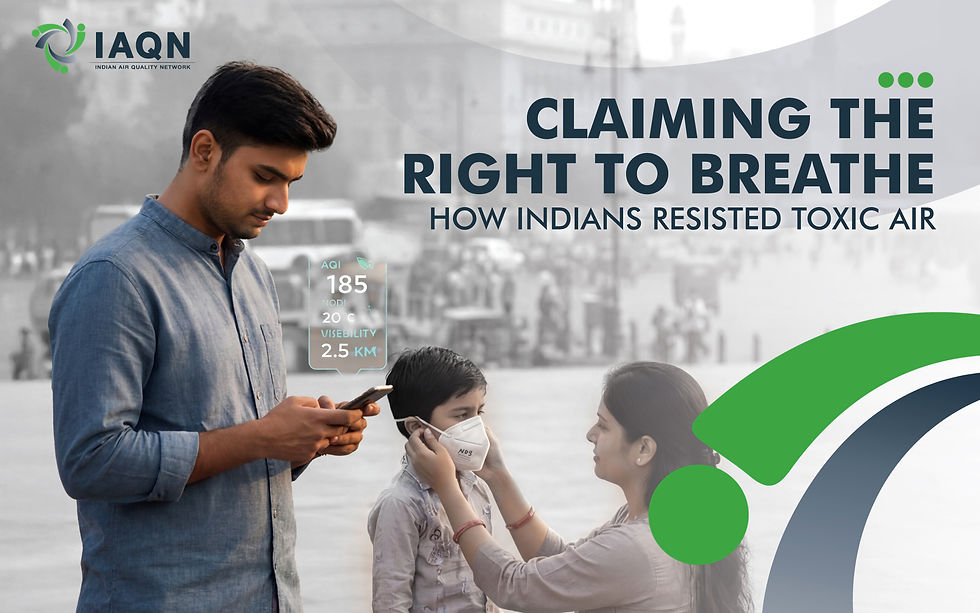
While courtrooms became important spaces for citizen resistance, the fight against bad air in 2025 was not confined to legal filings. Across cities, ordinary people also took to public spaces. Students, parents, and teachers organised protests and demonstrations, particularly during peak pollution episodes, demanding safer conditions for children. These actions reframed air pollution as a children’s rights and education issue, highlighting how toxic air affects attendance, learning outcomes, and long-term health. The visibility of children wearing masks and parents demanding action added a powerful emotional dimension to the debate.
At the neighbourhood and city level, citizen engagement also became increasingly data-driven. In places like Gurgaon, resident groups surveyed roads, identified dust hotspots, and submitted evidence-backed representations to municipal authorities. This marked a notable shift from complaint-based activism to evidence-informed civic action. Citizens were not only expressing frustration; they were producing information, mapping problems, and demanding accountability based on observable realities.
Alongside these collective efforts, millions of individuals quietly adjusted their daily lives in response to polluted air. Checking AQI before stepping out, limiting outdoor activities for children, wearing masks during high-pollution hours, and investing in indoor air quality solutions became standard practices. While these individual actions cannot replace systemic policy change, they reflect a broader public awakening. People increasingly recognised that polluted air is not “normal” and should not be silently tolerated.
Conclusion: A Defining Moment in India’s Clean Air Journey
What truly distinguished 2025 from earlier years was the tone and persistence of citizen engagement. The narrative shifted from short-lived outrage during winter smog to sustained demands for accountability, transparency, and long-term planning. Citizens spoke in the language of public health, constitutional rights, and intergenerational justice. Courts were not being asked for symbolic observations but for enforceable directions, timelines, and responsibility.
Taken together, the PILs and people-led actions of 2025 represent a critical moment in India’s clean air journey. They show a society beginning to reclaim environmental governance as a shared responsibility, where citizens do not merely wait for solutions, but actively shape them. Clean air is increasingly asserted not as a favour from the state, but as a right that must be protected, enforced, and defended.
If future narratives are written about India’s struggle with air pollution, 2025 may be remembered as the year when citizens stopped accepting toxic air as fate, and instead chose to question it, challenge it, and demand something better.
A Collective Responsibility
In this modern age, air quality is everyone's responsibility. Each action we take can contribute to a healthier planet. Planting trees, choosing public transportation, or supporting local clean air initiatives can make a difference. Awareness is the first step toward change.
Join us in advocating for cleaner air. Together, we can help nature regain its voice.
Let’s work together to ensure our world thrives in harmony with nature.


Comments